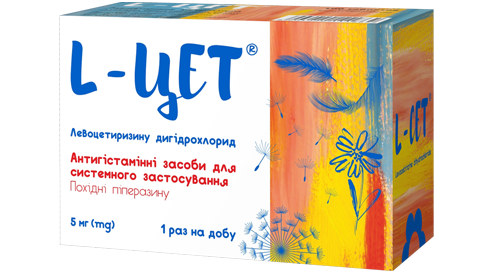



L-Set® - an effective remedy for allergies
What allergy treatment methods exist?
There are three main complementary methods of therapy:
- For patients with hay fever (outside the flowering period), cross-reactive food allergies,
as well as patients allergic to dust and pet hair, an allergist may prescribe specific
allergen immunotherapy. For this purpose, increasingly concentrated allergen solutions are
injected into the patient's skin over several weeks. Specific immunotherapy is conducted
in advance so that by the start of the flowering season, the body's sensitivity to
specific pollen is minimized. - A doctor may prescribe a special hypoallergenic diet and cessation of contact with the allergen.
- Without exception, all allergy patients are prescribed antihistamines. Why are they
called that? What does histamine have to do with it?
The answer lies in the very mechanism of allergy development.
Allergy is a pathologically increased reaction of the body to certain
substances called allergens (e.g., pollen) that normally do not cause illness. The
occurrence of an allergy involves a malfunction of the immune system. The immune system
suddenly begins to react to a completely harmless substance (such as the pollen of flowering
plants) as if it were dangerous. In the process, the body produces large quantities of
so-called "antibodies" against the pollen. When antibodies come into contact with the allergen
(pollen), the concentration of a biologically active substance — histamine — increases in
the body. It is histamine that, in hay fever, causes nasal congestion, profuse watery nasal
discharge, sneezing fits, nasal itching, itchy and red eyes, and tearing.
Antihistamines prevent the effects of histamine from manifesting. As long as a patient with
allergic rhinitis takes antihistamines, the symptoms are reduced. As soon as antihistamines
are stopped, the symptoms return. Unfortunately, medicine cannot yet eliminate the cause of
allergy (the "breakdown" in the immune system), but it can only reduce the negative
consequences by blocking the action of histamine. Some people, unaware of allergy mechanisms,
stop taking antihistamines prematurely (they feel relief from hay fever symptoms and stop
taking the drug). This is incorrect! Antihistamines should be taken throughout the entire
flowering period of the allergen plant. For example, when aggressive weeds like ragweed bloom
from July to September, the antihistamine must be taken during the entire flowering period.
Today, many antihistamines are sold in pharmacies.
Are they all the same?
There are several generations of antihistamines. It is important to know that old, first-generation antihistamines created over 50 years ago have a pronounced sedative effect and can cause side effects such as dry mouth and throat, urinary retention, and constipation. They are short-acting, thus needing to be taken 3–4 times a day. Furthermore, dependency (tolerance) develops when using old antihistamines.
The last generation of antihistamines differs from the predecessors:

High efficiency

Safety

Quick start action

Minimum side effects

Convenience of application
A representative of the new-generation antihistamine anti-allergic drugs is the drug
L-Cet®.
The active substance of L-Cet® — levocetirizine — was created
based on a scientific discovery that was awarded the Nobel Prize in Chemistry in 2001.
L-Cet® is available in tablet and syrup forms.