



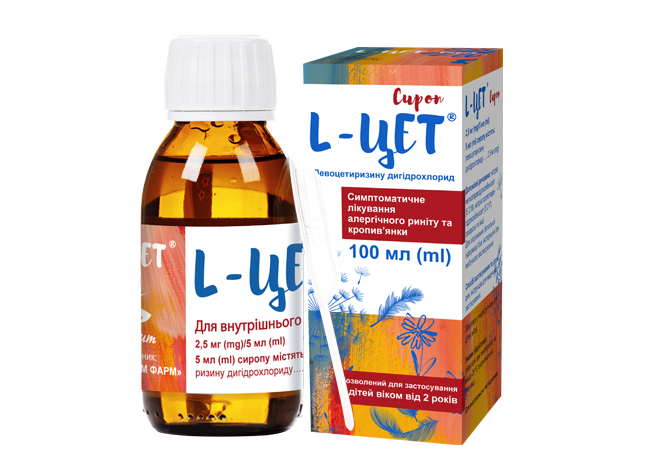
Shown for treatment:
- Allergic rhinitis (including perennial allergic rhinitis)
- Urticaria
Composition:
Active substance: 5 ml of syrup contains 2.5 mg of levocetirizine dihydrochloride;
Excipients: glycerol, propylene glycol, sodium
methyl parahydroxybenzoate (E 219), sodium propyl parahydroxybenzoate (E 217), sucrose,
glacial acetic acid, sodium acetate trihydrate, peppermint flavor,
banana flavor, purified water.
Pharmacological properties:
Prevents the development and alleviates the course of allergic reactions, exerts anti-exudative, antipruritic, and anti-inflammatory effects, and has almost no anticholinergic or antiserotonergic action.
Given the low degree of metabolism and the lack of metabolic inhibition capacity, interaction of levocetirizine with other substances (and vice versa) is unlikely.
Method of application and dosage:
| Patient category | Age | Single dose | Frequency of administration |
| Children | From 2 years to 6 years | 1.25 mg (2.5 ml) | 2 times a day |
| Children | From 6 years to 12 years | 5 mg (10 ml) | 1 time a day |
| Adolescents | From 12 years to 18 years | 5 mg (10 ml) | 1 time a day |
| Adults | From 18 years | 5 mg (10 ml) | 1 time a day |
Elderly patients with normal renal function do not require dose adjustment. For patients with impaired renal function, the dose calculation must be carried out taking into account creatinine clearance in accordance with the Instructions. Patients with only hepatic impairment do not require dose adjustment. Patients with both hepatic and renal impairment must adjust the dosing regimen in accordance with the Instructions.
Why do we choose L-cet syrup for allergies?
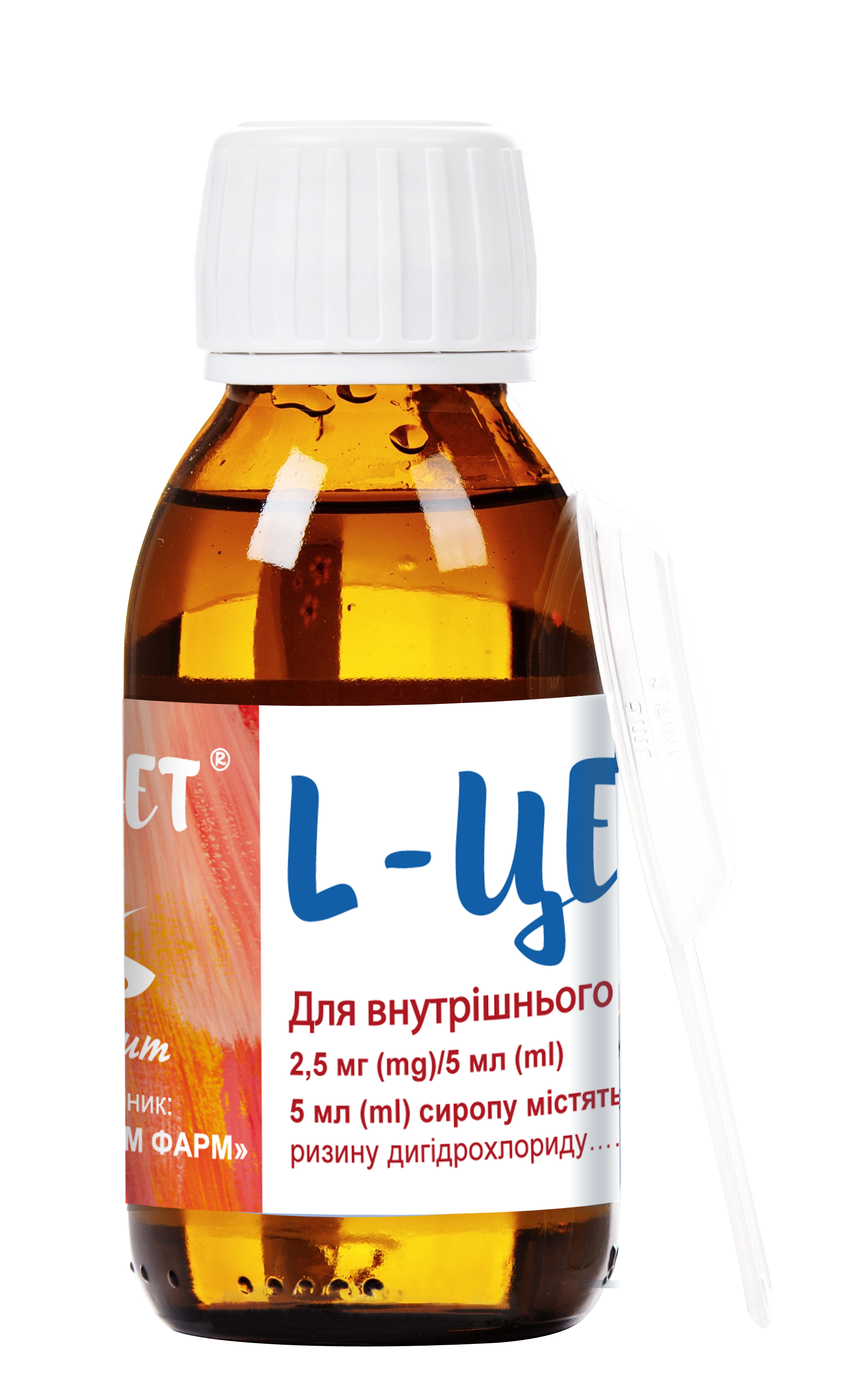
- Modern-antiallergic (levocetirizine is the active form of cetirizine – scientists received the Nobel Prize for its discovery!² This technology allowed for a reduction in the drug dose)
- Fast-effective (L-cet Syrup acts from the 12th minute after administration: in 50% of patients, the effect of levocetirizine develops 12 minutes after a single dose, and in 95% – within 0.5 – 1 hour)
- Nose-unblocking (L-cet Syrup helps eliminate nasal congestion, swelling, and reduces nasal discharge in allergic rhinitis)
- Itch-relieving (L-cet Syrup is indicated for the treatment of urticaria)
- For children and adults (L-cet Syrup is for everyone over 2 years old)
- Convenient-intake (L-cet Syrup is taken 1–2 times a day)
- Gently-treating (L-cet Syrup has a low frequency of side reactions)³
- Long-protecting (L-cet Syrup acts for 24 hours – that's super!)²
- Tasty-banana (L-cet Syrup – it's yum-yum!)
- Clear-dye-free (L-cet Syrup is completely free of dyes!)
- Food-independent (L-cet Syrup can be taken independently of food intake)
- Long-term-intake (L-cet Syrup can be taken for a long time)*
What to do for children with allergic rhinitis Recommendations for hay fever (allergy to plant pollen)
If a child's nose is blocked, eyes and eyelids are itchy during the flowering period, tearing and even choking, while an allergist found a positive reaction to the pollen allergen - these Recommendations for you.
Recommendations have been developed, following which during the pollination (flowering) season you will be able to limit
contact with pollen allergens:
- Exposure to the sun should be limited to a minimum; it is better to walk after rain, when the amount of pollen in the atmosphere significantly decreases. After being outside, you should wash your face or wipe it with a damp towel, change clothes, and take a shower, as pollen can collect in hair and fabrics.
- Avoid various kinds of out-of-town trips, visiting forests and meadows, parks, and squares.
- Windows and doors in your apartment or office should not be opened. Sleep with closed windows. To reduce the entry of pollen into the home, all windows (vents) should be covered with damp gauze or other woven materials, and the doors to the apartment should be kept constantly closed. It is best to ventilate the room after rain or in the evening, when the amount of pollen in the atmosphere significantly decreases. Wet cleaning must be carried out daily! The use of air purifiers and air conditioners plays a major role in improving the well-being of a patient suffering from hay fever. The use of an air conditioner with air filters at the outlet is recommended.
- The highest concentration of pollen in the air is observed early in the morning and on dry hot days; therefore, during this period of time, it is especially not recommended to go outside. After returning from the street, you should change your clothes.
- Take a shower at least twice a day. Take a shower when you come from the street. Be sure to wash your hair.
- During the period of exacerbation of the disease, it is necessary to perform nasal cavity hygiene daily and repeatedly, rinse the eyes, and rinse the throat with physiological saline solution (sodium chloride). For nasal irrigation, you can use nasal sprays with sterile sea water.
- Close the windows in the car during the trip, especially in the countryside. In order to protect yourself, it is recommended to wear tight-fitting glasses, and after returning home – be sure to change all clothes, take a shower, and thoroughly rinse your eyes and mouth with clean water.
- Do not dry clothes after washing outside (on the balcony), as pollen settles on them.
- Rest by the sea, where there is much less pollen.
Cross-food allergy⁵
| Pollen allergen | Food products |
| Pollen of birch, alder, hazel |
Hazelnuts, almonds, apples, pears, cherries, apricots, peaches, kiwi fruit, celery, potatoes |
| Pollen of wormwood |
Celery, potatoes, fennel, parsnip, anise, dill, red (cayenne) pepper, coriander, cumin, chamomile, sunflower seeds, drinks using wormwood (vermouths, balms) |
| Pollen of sunflower |
Sunflower oil, halva, mayonnaise, mustard |
| Pollen of ragweed |
Melon, banana |
| Pollen of grasses, rye |
Tomatoes, melons, peanuts, grain, soy |
| Fragrant herbs |
Spices, celery |
| Pollen of many plants |
Honey |
Questions and answers
Today in Ukrainian pharmacies. many antihistamines. Are they all the same?
There are several generations of antihistamines, and it is important to know that old first-generation antihistamines, created more than 50 years ago, have a pronounced sedative effect when used and can cause side effects such as dryness in the mouth and nasopharynx, urinary retention, and constipation. They act for a short time, which is why they must be taken 3–4 times a day. In addition, when using old antihistamines, tolerance develops. New-generation antihistamines differ from their predecessors by high efficacy and safety, a rapid onset of action, minimum side effects, and ease of use (one tablet a day is sufficient). A representative of the new-generation antihistamine anti-allergic drugs is L-Cet® by the pharmaceutical company "Kusum Healthcare Pvt Ltd". The active substance of L-Cet® — levocetirizine — was created based on a scientific discovery that was awarded the Nobel Prize in Chemistry in 2001. L-Cet® is available in tablet and syrup forms.
What are the main advantages and disadvantages of the L-Set drug?
As is well known, hay fever and urticaria are characterized by a sharp decrease in the patients' work capacity and quality of life. A patient with hay fever suffers from nasal discharge, nasal congestion, itching in the nose/eyes, and sneezing. A patient with urticaria suffers from itching, burning, and skin rashes. Firstly, L-Cet significantly reduces these symptoms; therefore, its use contributes to improving the quality of life and restoring work capacity. Secondly, L-Cet has a rapid onset of anti-allergic action – as early as 12 minutes after administration (in 50% of patients). Thirdly, L-Cet has practically no sedative effect, which is very important for people leading an active lifestyle. Fourthly, L-Cet has a high safety profile and minimum side effects. Its use is permitted for children (from two years old in syrup form, from six years old in tablet form), and no dosage adjustment is required for elderly patients. Fifthly, L-Cet is convenient to use – just 1 tablet per day. And finally, L-Cet is a modern, high-quality drug for allergy treatment at an affordable price.
What is allergy, why does it occur, and is it definitively possible? to recover from allergies?
Allergy is a pathologically increased reaction of the body to certain substances-allergens (for example, pollen), which normally do not cause morbid phenomena. A malfunction of the immune system is involved in the occurrence of allergies. The immune system suddenly begins to react to completely harmless substances (for example, the pollen of flowering plants) as dangerous ones. At the same time, so-called antibodies are produced in large quantities in the body against the pollen. When antibodies come into contact with the allergen (pollen), the concentration of a biologically active substance – histamine – increases in the body. It is histamine that causes nasal congestion, profuse watery nasal discharge, sneezing fits, itching of the nose, itching and redness of the eyes, and lacrimation. Antihistamines prevent the manifestation of histamine effects. And as long as a patient with hay fever takes antihistamines, the symptoms of hay fever decrease. As soon as the intake of antihistamines stops, the symptoms of hay fever return. Unfortunately, for now, medicine cannot eliminate the cause of the allergy (a failure in the immune system leading to allergy), but can only reduce the negative consequence of this failure – by blocking the action of histamine. Some people, not knowing the mechanisms of allergy, prematurely stop taking antihistamines (they feel relief from hay fever symptoms and stop taking the antihistamine drug). This is incorrect! An antihistamine must be taken throughout the entire flowering period of the allergen plant. For example, when such an aggressive weed as ragweed blooms in July-September, the antihistamine must be taken throughout the entire flowering period.
How should L-set be taken for pollinosis and urticaria?
Before using L-Cet, it is necessary to carefully read the instructions or
consult a doctor. L-Cet is available in tablet and syrup forms.
L-Cet tablets are recommended for adults and children over 6 years of age
at a dose of 1 tablet per day. The tablet is taken regardless of food intake
and washed down with a small amount of water. L-Cet syrup is recommended
for use in children over 2 years of age. Recommended doses of the syrup:
children 2–6 years old – 2.5 ml twice a day, and children over 6 years old –
10 ml once a day.